About us
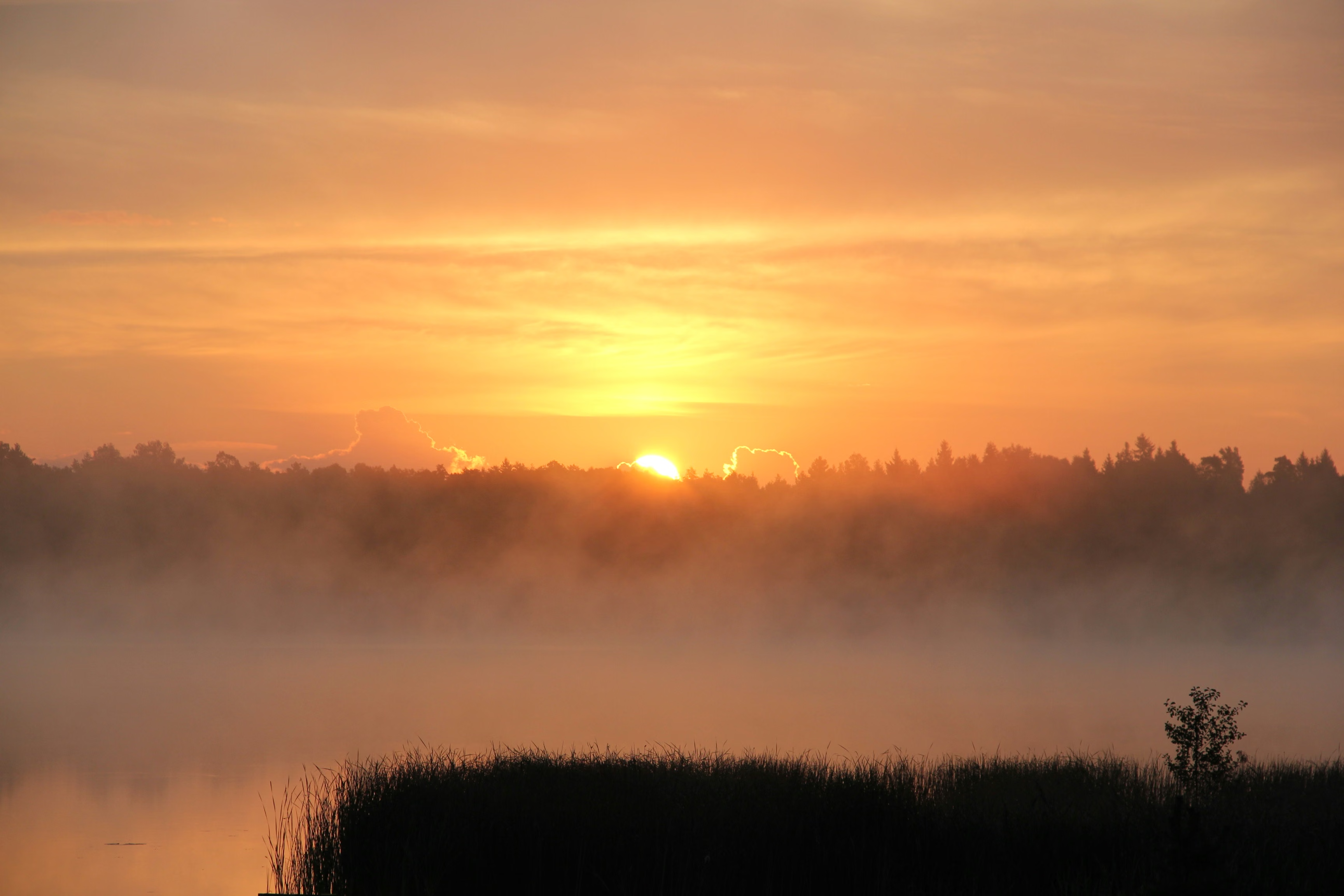
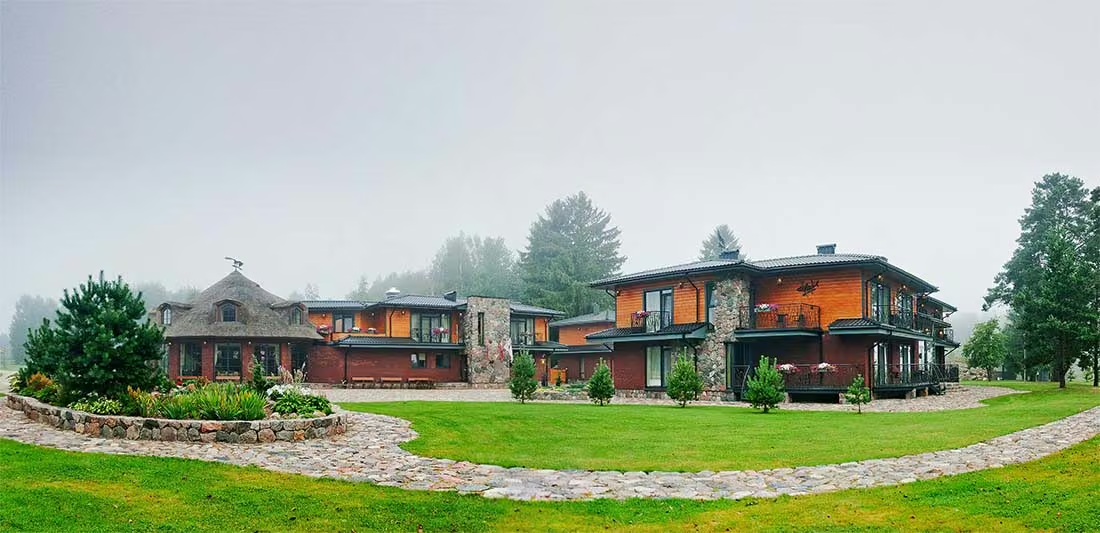
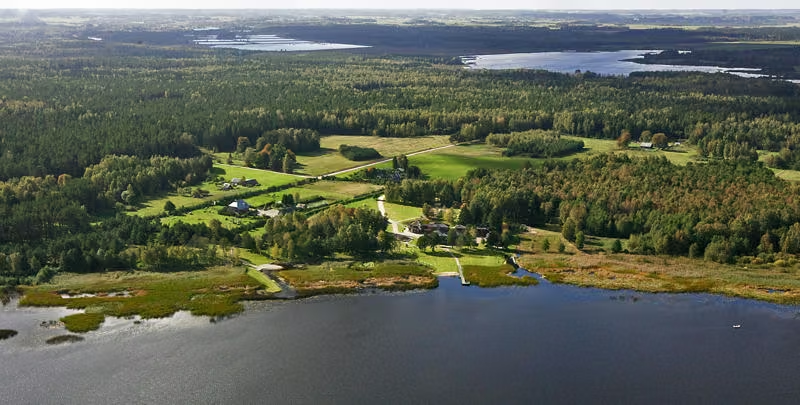
Come and discover Samogitia. Vila Dubgiris, a stylish countryside retreat on the shore of Lake Plinkšiai, opened to guests in 2012. The grounds cover nearly 4 hectares, with green lawns, shady pine woods, ponds full of fish and access to the shore of Lake Plinkšiai. The property comprises four buildings: Moose Lodge, the Bird Apartments with the spa and sauna complex, the Banquet Hall and Mother-in-Law's Cottage. The main hall at Moose Lodge displays a collection of hunting trophies from Europe, Siberia, the Far East and Africa. The lodge has 2 luxury apartments and 12 rooms for two, each identified without conventional room numbers.
Each room is named after a different woodland animal, with décor inspired by its habits and habitat. The three apartments in a separate building are named after birds and carry the theme through their interiors. Vila Dubgiris also has a small private sauna complex with a Finnish sauna that can be used with or without steam, as well as a Turkish steam bath. Take time to unwind in the hot tub, try the stone massage path, heated bench and experience showers, or visit the massage room and lounge. The estate’s Banquet Hall pairs elegant design with carefully chosen details.
Our two-storey Banquet Hall can host any celebration. The kitchen specialises in game and serves everything from traditional Samogitian dishes to more adventurous options. Upstairs, a fully equipped Conference Hall is available for training sessions and seminars. Set slightly apart is the log-built Mother-in-Law's Cottage, with a Russian bathhouse and an anteroom, an outdoor terrace with a fireplace and lake views, comfortable bedrooms, a spacious kitchen and a living room with a fireplace. On the well-kept grounds, you’ll find stocked ponds and a fish viewing area. If you catch a fish, we can prepare it for your lunch or dinner. Find a quiet spot in the birdwatching tower, sit under one of the gazebos or head to the Island Cabin in the middle of the pond. Take a pedal boat, rowboat, kayak, canoe or paddleboard out on Lake Plinkšiai to enjoy the scenery from the water. Explore the area by bicycle or play basketball, volleyball or table tennis at the sports area. Younger guests have a playground with climbing frames and swings. Vila Dubgiris is a place to slow down, recharge and make memories.
Local history
Vila Dubgiris is in the village of Uikiai, in Seda Eldership, Mažeikiai District. The village lies within the Plinkšiai Landscape Reserve, a Natura 2000 site. Lake Plinkšiai borders Uikiai to the east, the Domija flows from the lake in the north, and the Seda–Telšiai road passes through Uikiai Forest at the western edge of the village. Historical sources record that in the late 16th century, the nobleman Jonas Karolis Chotkevičius pledged the village to the Diocese of Samogitia and its seminary as security for a debt. This is the first documented mention of the village, which is recorded as early as 1596. At the start of the 20th century, five people lived on the outlying farmstead and 96 lived in the village itself. The population reached a recorded peak of 111 in 1923. Today Uikiai has 10 homesteads. This quiet corner of the countryside is part of the legacy of the Samogitian nobility who once flourished here. In the village centre, a small cemetery shaded by deciduous trees and ornamental shrubs has a chapel with two wrought-iron crosses. The community is small and close-knit. In 2000, residents put up a statue of Christ by Antanas Murauskas with the inscription “Christ, bless the people of Uikiai.” During the Soviet era, officials commissioned a bathhouse in Uikiai and a paved road was built to reach it.
Lake Plinkšiai and the surrounding forests
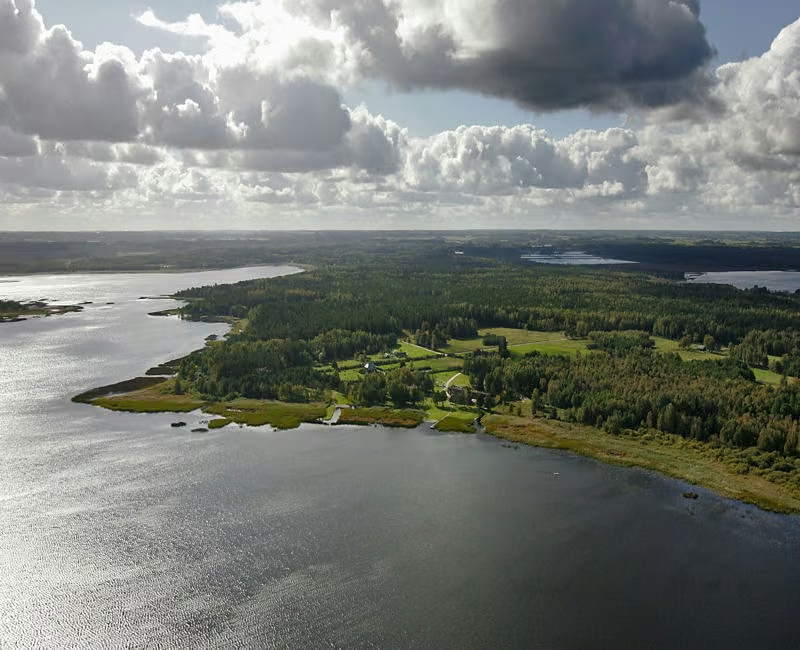
Lake Plinkšiai lies 5 km southeast of Seda. It covers 346 ha, stretches 5.5 km from south to north, and is up to 1.5 km wide. Its maximum depth is 11.7 m at the southern end and its average depth is 3.6 m. The winding shoreline forms a low, marshy terrace, with swamp forests on the eastern, southwestern and northwestern shores. The Juodė (from Lake Gudonas), Markija, Domija, Šilupis and Šaltininis streams feed the lake. The Šerkšnė, a left tributary of the Venta, flows out of it. Reeds and bulrushes form a strip 20–60 m wide along the banks. The lake surface is 110 m above sea level. It is rich in fish, including rare and valuable species such as zander, catfish, eels, pike and tench. During the Soviet era, the lake’s abundant fish stocks supported licensed commercial net fishing. The villages of Plinkšės, Užpelkiai, Pamarkija, Paplinkšė and Uikiai are on its shores. The lake is part of the 1,231 ha Plinkšiai Landscape Reserve, which spans Mažeikiai and Telšiai districts 5 km southeast of Seda, south of Plinkšės. Established in 1974, the reserve protects natural and cultural landscapes of the eastern Samogitian Upland. Least water-lily grows in the lake. Military orchid, northern firmoss, lesser twayblade and blue moor-grass are protected at the edges of the marsh. Great bitterns, gadwalls, Montagu’s harriers, marsh harriers and corncrakes breed here, and black storks, grey-headed woodpeckers and honey buzzards breed in the forest. Breeding pairs of white-tailed eagles and ospreys are seen each year. Black grouse, listed in Lithuania’s Red Data Book, breed in the Užpelkė woods. The reserve is home to otters, American mink and badgers, as well as rare bat species listed in Lithuania’s Red Data Book.
Plinkšiai Manor
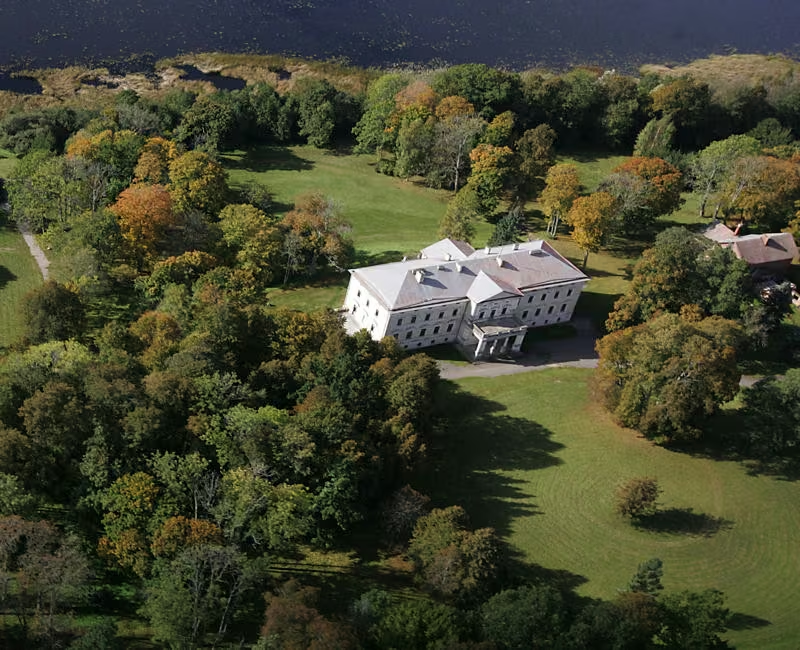
The earliest records of Plinkšiai Manor date to 1717. Surviving written sources attribute the two-storey, late neoclassical manor house on the lakeshore to Konstantinas Broel Plateris, who was born in Šateikiai in 1847 and died in Plinkšiai in 1899. He is thought to have begun work on his residence in Plinkšiai shortly after his marriage, around 1870. A German named Rozenbankas from Liepāja is believed to have overseen construction. The architect's identity remains unknown. A landscaped park surrounded the house. The Plater estate had three parts: the formal manor grounds, the garden and the farm area. The main house had two nearly identical 13-bay façades, with three-bay projections in the centre linked by triangular pediments. Pillars and columns supported large terraces with balustrades. After Konstantinas Plateris died, his elder daughter Olga inherited the estate. Her husband, Iljinskis–Kašauskas, lived in Poland. After the First World War, from 1918, his representative D'Ersevilis managed the estate. When O. Kašauskienė died, he also became guardian to her daughter Marija. In 1934, the Ministry of Agriculture bought the main part of the estate and established an agricultural school there. The school later became a technical college and closed in 1977. In 1981, the estate was transferred to Mažeikių nafta. Between 1983 and 1987, the company built a health resort in the manor park. The grave of Count Konstantinas Plateris (1847–1899) survives by Lake Plinkšiai. According to local lore, the count was buried at Švedkapis, and relatives secretly moved his remains to the family burial plot during the night. His wife, unaware of the move, erected a monument. A small fence enclosed it, trees were planted around the grave and spruces lined both sides of the approach.
Seda
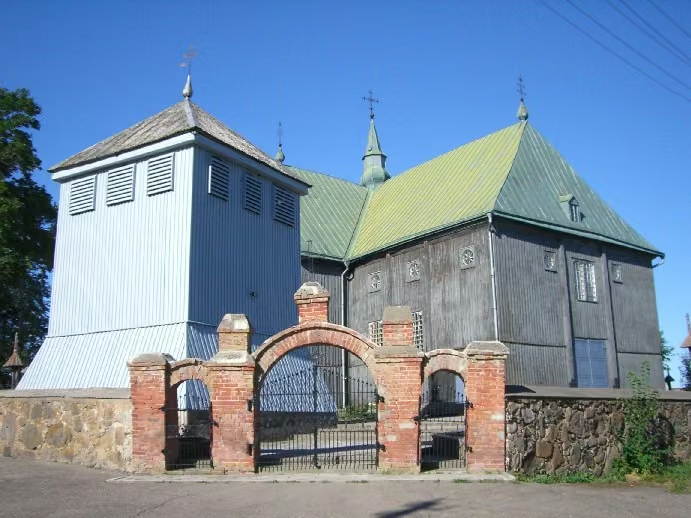
Seda is a town and the administrative centre of its eldership in Mažeikiai District, 24 km southwest of Mažeikiai. It stands at the junction of seven roads leading to Telšiai, Mažeikiai, Plungė, Renavas, Žemalė, Rubikai and Navarėnai. Linguist Kazimieras Būga traced the town's name to nearby Lake Seda, also known as Sedula. Seda has two wooden churches listed as architectural monuments, the Church of the Assumption of the Blessed Virgin Mary dating to 1770 and the Church of St John of Nepomuk dating to 1783. The street network, layout of the town square and parts of the historic built environment are listed as urban heritage of local significance. Seda appears in records as early as the 13th century. By the 15th century, it was gaining prominence as a busy trading centre on the border with Livonia. There was already a small town in 1500. A church was built by the manor in the early 16th century, and a parish was founded in 1508. Seda received the right to hold markets and fairs in 1655. Its position on the road from Livonia to Samogitia helped it grow. The town suffered heavy damage in the mid-17th century and during the Northern Wars, then recovered in the second half of the 18th century. It received new fair privileges in 1780, when it was referred to as a town. The construction of a new road in 1765 set the route for what is now Bažnyčios Street. In 1914, all the houses on the marshy left side of the Sedula stream were built on pine piles. After the 1831 uprising, in which the Sapieha family who owned Seda took an active part, the state confiscated their holdings in the town. Local residents also took part in the 1863 uprising by distributing banned publications. In 1855, the bishop and poet Antanas Baranauskas worked in Seda. The town's central square bears his name and was renovated in 1999. A bust of Baranauskas by sculptor Osvaldas Neniškis was installed in 2000. The town's coat of arms was approved by presidential decree on 16 July 2004.
Maidens' Hill (Panų or Mergų Kalnas)
The historic Mergų Hillfort lies between Lake Plinkšiai and the Sruoja River. At about kilometre 10 on the main Telšiai–Seda road, a cross marks the path into the forest to Panų Hill, also called Mergų Hill. The site was added to Lithuania's Register of Cultural Heritage on 23 December 1996. Known for its legends, it is a long, sandy hill covered in pines and surrounded by marshes. It is about 210 m long and 100–150 m wide, with gently sloping sides 5–6 m high. Most of the recorded legends tell of Swedish raids and young Samogitian women determined to protect their honour. In ancient times, the hill is said to have been heavily fortified, with a network of underground caves used as shelters. According to legend, when Swedish forces invaded Samogitia in the 17th century and devastated the region, local girls and young women took refuge in the hillfort. The Swedes were surprised to find no young women. When they eventually discovered the hiding place, they sealed the entrance, burying some 2,000 girls and young women. The hill has been known as Mergų Hill ever since. A chapel was built on the hill in their memory. At its foot is a spring whose water people once used to treat their eyes. Mass is still celebrated on the hill, and pilgrims leave crosses around the chapel, some woven from twigs or willow shoots. People come to lay down their troubles, offer prayers and leave feeling spiritually renewed.
Renavas Manor
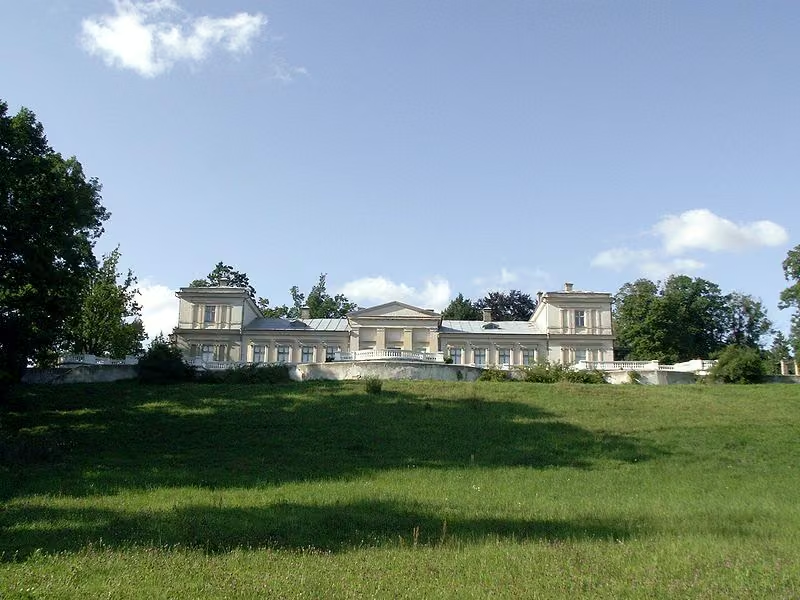
Renavas Manor and its surrounding park are in the village of Renavas, in Seda eldership, Mažeikiai district. The manor is one of Samogitia's most interesting and best-preserved historic estates. Written records mention Renavas Manor as early as the 16th century, when it was a wooden building with a thatched roof. A small masonry building is believed to have stood here by the late 18th or early 19th century. The estate was once called Gaurai. It gradually took the name Renavas after the Renne family acquired it in the late 17th century. In the first half of the 19th century, the estate belonged to Antanas Renė, who was widely known for his love of gardening. After his death it passed to Eugenijus Renne and later to Count F. Mielžinskis, who laid out a new park of about 6 hectares beside the Varduva River. Local tradition says that visitors should hug the great Renavas spruce and see the Renavas linden tree. Around 1880, the modest but ornate manor house at the top of the slope was rebuilt. It was known for its valuable collections of paintings and antique works of art. The Mielžinskis family took particular pride in its antique porcelain made in European cities. Restoration of the manor house began in 1980, during the Soviet period. The original manor library interior has been preserved. It once held more than 1,000 volumes, mostly finely bound editions in German and Latin. The newer library mainly held publications from the second half of the 19th century, most of them in Latin. The restored manor house now houses a branch of the Mažeikiai Museum. Its rooms display works of art and host travelling exhibitions. Some scenes from the popular feature film “Tadas Blinda. Pradžia” were also filmed at Renavas Manor.
Samogitia National Park
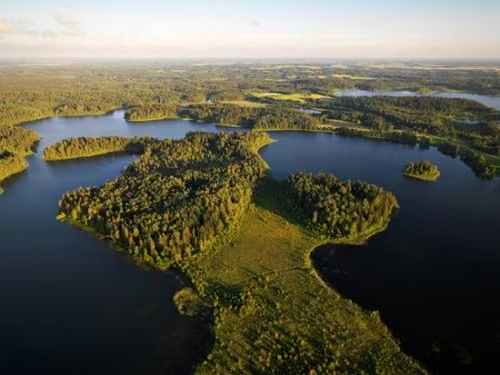
Žemaitija National Park and its centrepiece, Lake Plateliai, are just 35 km from Vila Dubgiris. Visit the town of Plateliai and its manor estate, walk the park’s well-marked nature trails, and explore the Cold War Museum at a former underground missile launch site.
More about the park: www.zemaitijosnp.lt
Raudonoji Bog
Raudonoji Bog lies in Židikai eldership, 10 km northwest of Seda. Its name, meaning 'red bog', comes from the lake that once occupied the site. At sunset the water appeared deep red. Over the years, the lake gradually filled in and became a peat bog. Part of it lies in Skuodas district. An area of 269 hectares is recorded, of which 170 hectares are worked. The total area is 352 hectares. Raudonoji Bog formed 8,000 years ago. The peat bog has been commercially worked since 1972 and formerly belonged to the Telšiai peat company. Planning began in 1965, when the peat deposits were measured at 8 metres deep. Peat extraction began in 1966. In 2003, a major fire spread across about 200 hectares of the bog.
Žemaitijos žuvis
Just 1 km from Vila Dubgiris, across the Seda–Telšiai road and deep in the woods around Uikiai, the village of Gedrimai is home to the former Pasruojis state fish farm. The owners and staff of UAB Žemaitijos žuvis now care for the extensive grounds and breed several species of fish. The area supports large colonies of many bird species. Breeding white-tailed eagles, ospreys, black storks, honey buzzards and northern shovelers are often seen, along with other protected birds listed in Lithuania's Red Data Book.